Built for careful adoption
Japanese companies often ask where AI may act, who remains accountable, and what evidence remains. Naikaku makes those boundaries visible.
Japan-built · Japanese-primary · Cautious AI adoption
Naikaku brings planning, coding runners, sandbox execution, critique, supervision, and evidence-based iteration into one governed workbench shaped by Japanese operating requirements.
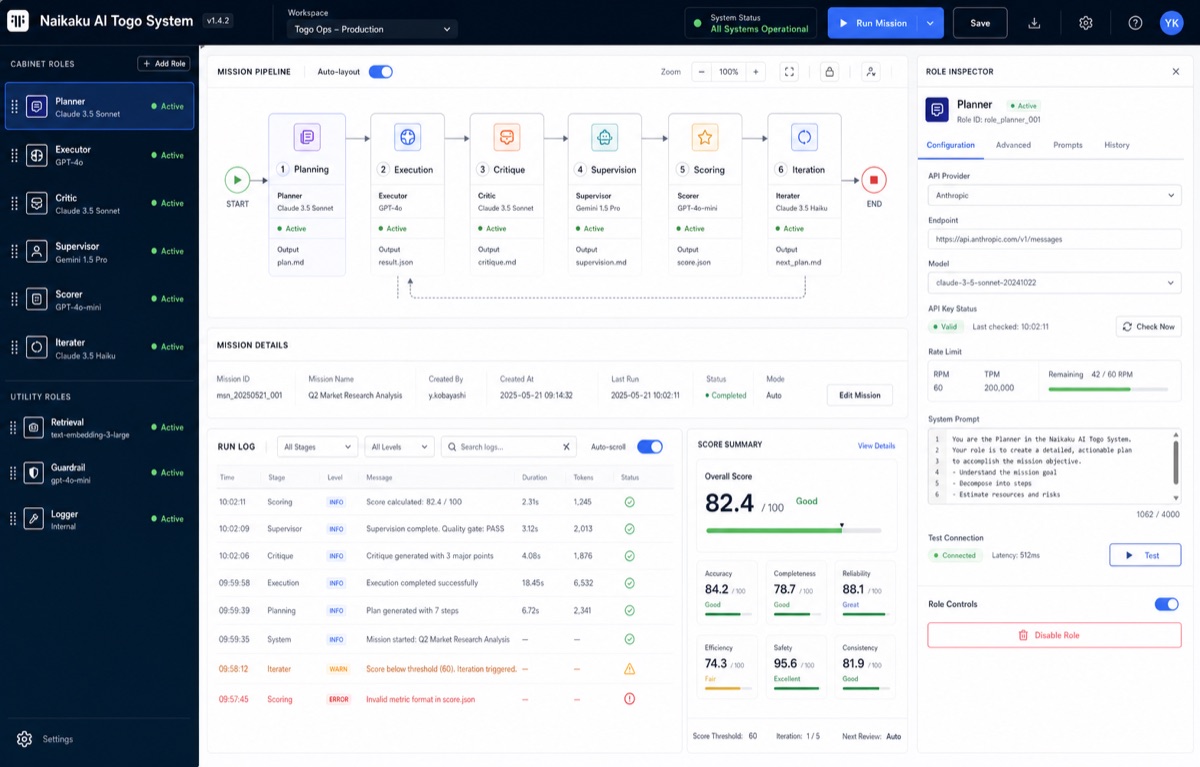
Instead of handing work to one unchecked model, Naikaku separates planning, execution, critique, supervision, safety, memory, and scoring. Execution sits behind presets, readiness checks, logs, receipt review, and artifact audit.
Japanese companies often ask where AI may act, who remains accountable, and what evidence remains. Naikaku makes those boundaries visible.
The system is shaped for customer automation needs, research loops, investigation workflows, and engineering checks.
EMYSTI is releasing the approach as noncommercial public source so developers can inspect, fork, and contribute.
AI adoption in Japan often has to satisfy legal, information-control, quality, and customer-explanation concerns. Naikaku responds by separating proposal from execution and putting reviewable evidence at the center.
Run repetitive work, research, reports, and code checks with scoped permissions and evidence.
Compare model viewpoints, critique, retry, and preserve records in the same workspace.
Even when an AI runner performs work, receipts and artifact review keep final acceptance explicit.
EMYSTI Hero Series
VisitHero, TransHero, StayHero, and HanasuHero are not isolated app ideas. Naikaku is the EMYSTI AI workbench that helps separate planning, verification, translation, implementation, and supervision before work reaches people in the field.
A Japan-based builder connecting AI, multilingual systems, and human dignity.
Field MapMultilingual help that turns uncertainty in Japan into the next practical action.
CommunicationTranslation as daily infrastructure for healthcare, public offices, and field work.
Life in JapanA multilingual community that reduces loneliness and anxiety for life in Japan.
Everyday JapaneseAI that turns everyday Japanese at home and school into point-reading, translation, and read-aloud support.
Start locally, check provider aliases and the gateway, then attach runner presets only when you need them. Raw API keys should stay out of browser storage.
Get the macOS developer preview from GitHub Releases.
2Use npm ci and npm run dev to open the Workbench.
Run npm run gateway for local provider and runner routes.
Configure provider, endpoint, model, and API-key alias per role.
5Allow only the CLI runners you choose, with evidence required.
Try it, connect APIs, supervise a Mac runner, or contribute. Each entry point keeps the same language structure.
Run steps, verification commands, and checksums.
Bring-your-own keys and future hosted gateway.
Boundaries for CLIs and Mac automation.
Pick the entry point by intent.
Contributions, adapters, and verification.
Noncommercial source and commercial permission.
Japanese stays the primary language, while English and Chinese keep matching pages, matching routes, and matching license boundaries.
The same content structure is available.
The same content structure is available.
The same content structure is available.
It is an AI cabinet workbench where multiple roles plan, execute, critique, supervise, score, and preserve evidence.
Yes. Each role can use its own provider, endpoint, model, and API-key alias.
The public release is for noncommercial use. SaaS, client delivery, commercial modification, and paid integration require written permission from EMYSTI LLC.